
For most learner drivers, parallel parking is the one manoeuvre that turns confidence into nerves. Unlike a straight-line reverse or a simple three-point turn, parallel parking asks you to judge distance, angle and timing all at once, often with traffic waiting behind you. The good news is that parallel parking isn’t about memorising a magic steering trick. It’s a skill built from correct positioning, smooth steering control, constant observation and steady practice.
This guide breaks the manoeuvre down step by step for learner drivers across Melbourne, including those preparing for their VicRoads driving test in the western suburbs. Whether you’re a nervous first-timer or simply want to sharpen your technique before test day, these steps will help you park calmly, safely and correctly.
Why Parallel Parking Is Important for Learner Drivers
Parallel parking is one of the clearest tests of vehicle control a learner driver will face. It requires you to coordinate steering, mirror checks, speed and spatial awareness in a tight space, which is exactly why it often appears in driving test assessments.
Beyond the test, it’s a genuinely useful everyday skill. Many Melbourne streets, especially around shopping strips and inner suburbs, only offer kerbside parking. Learners who feel confident parallel parking have more options when they’re out driving and less anxiety about finding a spot.
It’s worth remembering that examiners and instructors care far more about how safely and smoothly you complete the manoeuvre than how fast you do it. Rushing is one of the biggest causes of mistakes. Slow, controlled movements paired with good observation will always beat speed.
What You Need to Know Before Parallel Parking
Before you even start reversing, a few checks set you up for success:
- Mirrors – Check your rear-view and side mirrors continuously, not just once.
- Blind spots – A quick shoulder check confirms nothing your mirrors might miss, such as a cyclist or pedestrian.
- Indicators – Signal your intention to park so surrounding traffic knows what you’re doing.
- Traffic awareness – Watch for vehicles approaching from behind before you slow down.
- Choosing a suitable space – As a beginner, look for a gap at least one and a half car lengths longer than your vehicle.
- Vehicle positioning – Your starting position relative to the car in front of the space matters more than the steering angle you use.
- The kerb and surrounding vehicles – Get a sense of where the kerb sits and how much clearance you have from the cars in front and behind.
Getting these basics right before you start reversing takes the pressure off the steering itself.
How to Parallel Park Step by Step
Here’s a practical, beginner-friendly process for how to parallel park:
- Find a suitable parking space. Look for a gap that comfortably fits your car with room to manoeuvre.
- Check mirrors and surroundings. Confirm no traffic or pedestrians are approaching.
- Signal your intention. Indicate early so other drivers can anticipate your move.
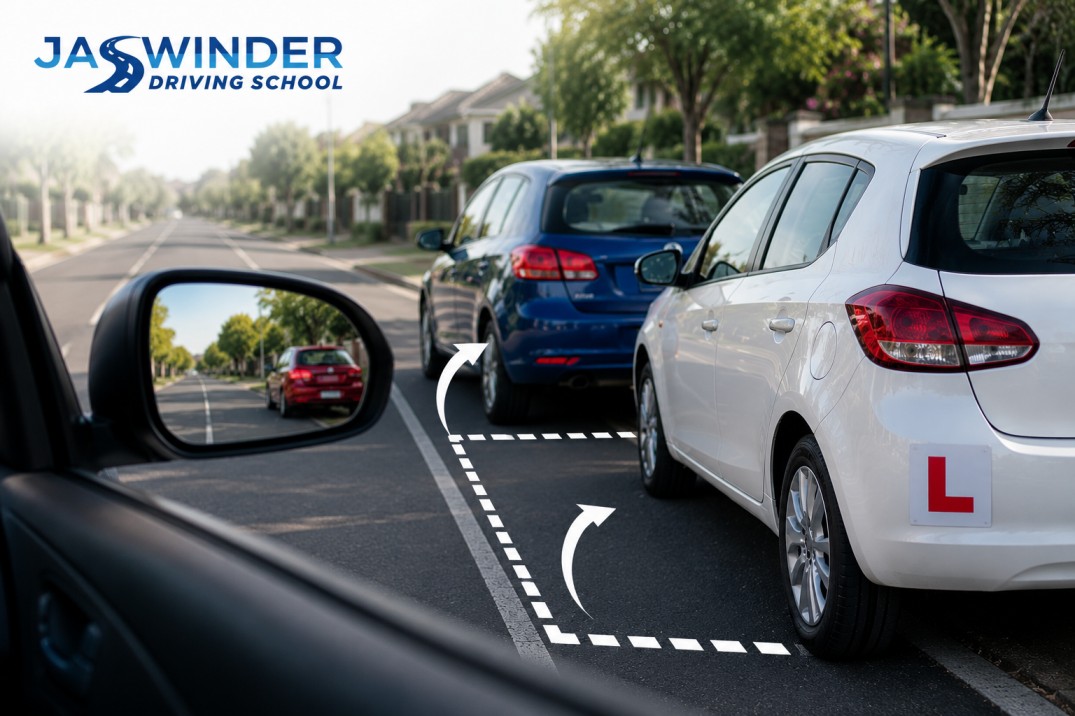
- Position your vehicle correctly. Pull up alongside the car in front of the space, leaving roughly half a metre to a metre of side clearance.
- Stop in the correct starting position. Your rear bumper should typically line up close to the rear bumper of the car beside you (this varies slightly by vehicle, which we’ll cover below).
- Begin reversing slowly. Keep your speed low; this is where most learners feel rushed, but slow and steady wins here.
- Turn the steering wheel smoothly toward the kerb once you reach your reference point, rather than jerking it.
- Continue checking mirrors and blind spots throughout the reverse, not just at the start.
- Straighten the vehicle as it enters the space, easing the wheel back toward centre.
- Make small corrections if required. It’s completely normal to pull forward slightly and adjust; this isn’t a failure, it’s good practice.
- Finish safely and check your final position. Confirm you’re parallel to the kerb, within a reasonable distance (VicRoads guidance is generally within about half a metre), and clear of the vehicles in front and behind.
Each stage matters as much as the last. Learners who focus only on the steering wheel and skip the observation steps tend to struggle more than those who treat parking as a full sequence.
Parallel Parking Reference Points
Many learners are taught to use a visual reference point, such as watching for when a specific point on the rear window or side mirror aligns with the kerb or the neighbouring car, as the cue to start turning.
These reference points are genuinely useful, but they’re not universal. They vary depending on:
- Vehicle size and length
- Your seating position and adjustment
- The specific make and model you’re driving
- Your instructor’s preferred teaching method
Rather than relying on a single steering formula, it’s more reliable to build a feel for your own car’s dimensions through repeated practice. If you’re training in a driving lesson with dual-control vehicles, your instructor can help you find reference points specific to that car.
Common Parallel Parking Mistakes Learners Make
- Starting too far from the parked vehicle – makes it hard to swing in cleanly. Aim for closer alongside positioning.
- Starting too close – increases the risk of clipping the other car. Leave enough side clearance before you begin.
- Reversing too quickly – reduces your reaction time. Slow down and control your speed with the brake, not the accelerator.
- Turning the steering wheel too early – can angle you into the kerb. Wait for your reference point before turning.
- Turning too late – can leave you too far from the kerb. Practice timing with slow, repeated attempts.
- Forgetting mirror checks – increases risk to pedestrians and cyclists. Build mirror checks into every stage, not just the start.
- Missing blind-spot checks – mirrors alone don’t show everything. A shoulder check should become automatic.
- Not signalling correctly – confuses surrounding traffic. Indicate before you slow down to park.
- Ending too far from the kerb – affects road positioning and can be marked down in a test. Straighten up and, if needed, pull out and try again.
- Hitting or mounting the kerb – usually caused by turning too sharply too soon. Go slower and check your angle regularly.
- Focusing only on the steering wheel – forgetting mirrors and surroundings is a common beginner habit. Practice splitting your attention.
- Panicking when the first attempt isn’t perfect – it’s normal to need a correction. Pulling forward and adjusting is a completely acceptable part of the manoeuvre, including in the actual driving test.
How to Parallel Park Without Getting Nervous
If parking makes you anxious, you’re far from alone. A few practical habits help:
- Slow down. There’s rarely a real time pressure once you’ve signalled and positioned safely.
- Break the manoeuvre into stages. Think “position, reverse, check, straighten” rather than trying to do everything at once.
- Focus on observation first. Good awareness naturally leads to better steering decisions.
- Practise in a safe, quiet environment before attempting busy streets.
- Avoid rushing, even if there’s a car waiting. Most drivers are patient with a learner using their indicator.
- Repeat the manoeuvre regularly. Confidence comes from repetition, not from getting it perfect once.
- Ask a qualified instructor for feedback. An outside perspective picks up habits you might not notice yourself.
- Learn from mistakes instead of panicking. Every learner needs a few adjustment attempts; it’s part of the process, not a sign you’re doing badly.
Parallel Parking Tips for Automatic and Manual Cars
The core technique is the same regardless of transmission, but there are a few practical differences worth knowing.
For manual learners:
- Use clutch control to keep your reverse speed low and steady.
- Avoid unnecessary acceleration; a light touch on the accelerator (or none at all on a slight decline) is usually enough.
- Practise finding the biting point so you’re not relying on the brake alone to control speed.
For automatic learners:
- Rely on brake control rather than the accelerator to manage your speed.
- Keep your foot resting lightly and ready, easing off the brake just enough to creep backward smoothly.
- Avoid excessive acceleration, which can make fine adjustments harder to control in a tight space.
Both automatic and manual learners benefit from the same fundamentals: slow speed, steady observation and a willingness to make small corrections.
How to Practise Parallel Parking Effectively
A structured approach helps the skill stick:
- Start somewhere quiet and safe, such as an empty car park, where you’re not under pressure.
- Use cones or suitable markers to represent the vehicles you’d be parking between, if appropriate and safe to do so.
- Practise vehicle positioning before you even attempt to reverse.
- Practise reversing slowly, focusing purely on speed control at first.
- Repeat the same manoeuvre several times until it feels familiar.
- Gradually change parking spaces and conditions, including on quiet streets with real kerbs once you’re ready.
- Practise observation at the same time as steering, rather than treating them as separate skills.
- Get instructor feedback regularly to catch and correct small habits early.
Always practise legally and safely, under appropriate supervision and in line with your learner permit conditions.
Parallel Parking and Your Melbourne Driving Test
Parking is one part of a broader assessment during your VicRoads driving test, which also looks at observation, vehicle control, road positioning, safe reversing, speed control, signalling and awareness of other road users. Examiners are assessing whether you can drive safely and confidently in line with Victorian road rules, not just whether you can complete a single manoeuvre perfectly.
It’s worth noting that the exact manoeuvre required can vary between test locations and individual tests, so it’s best to prepare broadly rather than assume parallel parking will definitely appear. Reviewing the official Road to Solo Driving handbook is a good way to understand exactly what’s expected on test day.
When Should You Get Help From a Driving Instructor?
Self-practice goes a long way, but professional instruction can make a real difference if you:
- Repeatedly hit the kerb despite practice
- Struggle to judge distances between vehicles
- Find reversing especially difficult
- Get nervous specifically during parking manoeuvres
- Are preparing for your VicRoads test soon
- Want structured feedback on your observation and positioning
- Have practised a lot but still lack confidence
Jaswinder Driving School provides personalised driving lessons for beginners, nervous drivers and learners preparing for their VicRoads test across Melbourne’s western suburbs, with both automatic and manual lessons available.
Why Choose Jaswinder Driving School for Learner Driver Training?
Learning a manoeuvre like parallel parking is often easier with a patient, experienced instructor guiding you through it in real conditions. Jaswinder Driving School offers:
- Experienced driving instruction across Melbourne’s Western suburbs
- Beginner-friendly lessons designed to build confidence gradually
- Dedicated support for nervous learners
- Both automatic and manual driving lessons
- VicRoads test preparation, including familiarity with local test routes
- Dual-control vehicles for added safety during early lessons
- Flexible lesson scheduling, seven days a week
- Pick-up and drop-off availability
You can read more about the school’s approach on the About Us page, check current pricing, or see what past students say on the reviews page.
Learners across Werribee, Point Cook, Wyndham Vale, Truganina, Melton, Hoppers Crossing, Deer Park, Altona and Tarneit can access lessons close to home, with instruction tailored to local streets and test routes.
Frequently Asked Questions About Parallel Parking
How do you parallel park for beginners?
Start by positioning your car alongside the vehicle in front of the space, then reverse slowly while checking your mirrors, turning toward the kerb at the right point, and straightening up as you enter the space. Small corrections along the way are normal.
What is the easiest way to learn parallel parking?
Practise in a quiet, safe space first, using cones or markers to simulate the manoeuvre without the pressure of traffic. Repetition, rather than a single steering trick, builds the skill.
How long does it take to learn parallel parking?
It varies by learner, but most people become noticeably more confident after several focused practice sessions, especially with instructor feedback to correct small habits early.
What are the most common parallel parking mistakes?
Reversing too quickly, turning the steering wheel too early or too late, and forgetting mirror or blind-spot checks are among the most frequent issues for learners.
How close should you park to the kerb?
Aim to finish reasonably close and parallel to the kerb, generally within about half a meter, without mounting it.
Is parallel parking difficult for learner drivers?
Many learners find it challenging at first because it combines steering, observation, and spatial judgement in a tight space. It becomes easier with structured practice.
Can a driving instructor help me learn parallel parking?
Yes. An instructor can identify reference points specific to your vehicle, correct small habits, and provide a safe, dual-control environment to practice in.
Should I practice parallel parking before my driving test?
Yes, since parking is part of the broader skills assessed during a VicRoads test. Practicing in varied, realistic conditions helps build genuine confidence rather than memorized movements.
Final Thoughts
Parallel parking feels intimidating at first, but it comes down to a manageable process: position correctly, move slowly, observe constantly and be willing to make small corrections. With consistent practice, most learners find it becomes one of the more predictable parts of driving rather than the most stressful.
If you’d like structured, patient support to build your parking skills and prepare for your Melbourne driving test, Jaswinder Driving School offers lessons tailored to your comfort level and pace.
Call 0430 361 821
Email jaswinderdrivingschool@gmail.com to book a lesson.